Miami Jet Boat Rentals
How Much Does It Cost to Rent a JetCar in Miami?
Renting a JetCar in Miami costs about $350 an hour. That covers a supercar-styled jet boat carrying one or two riders, and operators typically include the speedboat transfer out to the craft. Anyone born on or after January 1, 1988 must carry a Florida Boating Safety Education ID card to drive one.
Get a quote
1 / 3- $350/hr
- Typical hourly rate
- 1–2
- Riders per JetCar
- Born on/after Jan 1, 1988
- Boater card required
as of 2026-07-16
as of 2026-07-16
as of 2026-07-16
Everything you're wondering
How much does a JetCar cost to rent in Miami?+
About $350 per hour for a JetCar carrying one or two riders, typically including the speedboat transfer out to the craft. Some operators also offer shorter half-hour sessions; confirm that pricing directly, as it is not simply half the hourly rate.
Do I need a boating license to drive a JetCar in Miami?+
Florida does not issue a boating license as such, but anyone born on or after January 1, 1988 must have completed an approved boating-safety course and carry a Boating Safety Education Identification Card plus photo ID to operate. Operators verify this before you ride.
How many people fit in a JetCar?+
One or two riders per craft. A larger group therefore means multiple JetCars rather than a single bigger vessel, which is worth factoring into the budget before you book.
Where can you drive a JetCar in Miami?+
The riding area generally spans Haulover Inlet to the Julia Tuttle Causeway — a large stretch of protected water. Exact routes vary with weather and sea conditions, and operators reschedule when it gets rough.
The full guide+
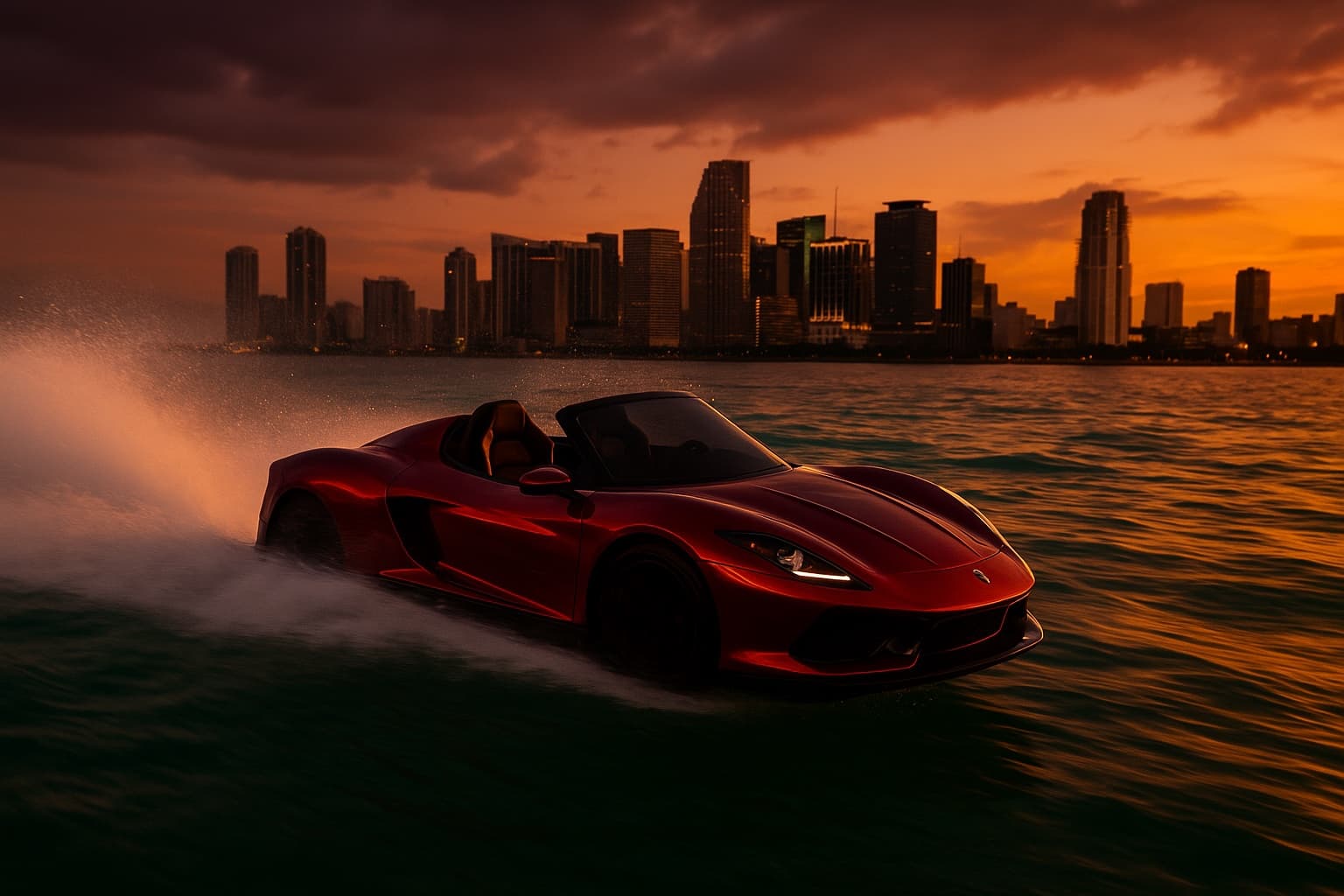
A JetCar in Miami rents for about $350 an hour, and that figure is consistent enough across operators to treat as the market rate rather than one company's asking price. What you are paying for is not a boat in the ordinary sense: a JetCar is a jet-driven watercraft wrapped in the bodywork of an exotic car, with a low profile, bucket seats, a steering wheel, and a real dash. It seats one or two riders. Underneath the styling it runs a supercharged 1.8-litre Yamaha jet engine, rated 250 HP on the two-seat model per published manufacturer specifications, and most cruise comfortably in the 40 to 60 mph range on the water.
The hourly rate usually includes more than the craft itself. Operators generally run the JetCars from a mooring rather than a dock, so a free speedboat transfer out to them is standard and included in the price. Bluetooth speakers are common on current models. Sessions are staff-monitored, meaning someone is on the water keeping an eye on the group rather than handing you the keys and waving goodbye. Shorter half-hour sessions are offered by some operators alongside the hourly booking, though pricing for those varies enough that it is worth confirming directly rather than assuming half the hourly rate.
The rule that catches people out is the same one that governs every powered vessel in Florida, and it is not something a rental company can waive. Anyone born on or after January 1, 1988 must have completed an approved boating-safety course and must carry a Florida Boating Safety Education Identification Card, together with a photo ID, in order to operate. Operators state this requirement explicitly on their booking pages and check for the card before you get on the water. If you were born before that date the requirement does not apply to you, which is why a group can sometimes ride while one member cannot. Several Miami operators offer a short on-site course for riders who arrive without a card, but that is a courtesy rather than a guarantee — confirm it exists before you build a booking around it.
Where you can drive matters as much as what you are driving. The JetCar riding area in Miami generally runs between Haulover Inlet at the north end and the Julia Tuttle Causeway to the south, which is a genuinely large stretch of open, protected water and the reason these rentals feel less constrained than a roped-off jet ski pen. Routes shift with weather and sea conditions, and operators adjust or reschedule when the wind gets up. That is not an inconvenience to argue with. A jet-driven craft with a low freeboard is exhilarating in flat morning water and unpleasant in a two-foot chop, so the calm-conditions call is usually the right one.
Jet propulsion is also the reason a first-timer can drive one at all. There is no exposed propeller under the hull — an impeller pulls water in and fires it out through a steerable nozzle — which means the craft turns tightly, sits in shallow water, and is far safer around swimmers and the sandbar than a propeller boat. The tradeoff is that steering authority comes from thrust, so the machine responds to the throttle in a way that takes a few minutes to internalize. Every rental starts with an orientation covering the controls, the throttle, and the no-wake zones, and that briefing is the difference between a confident hour and a tentative one.
For budgeting, treat $350 an hour as the base and ask three questions before you book: whether the security deposit is authorized on a credit card and for how much, whether your session is monitored or guided, and what the weather-cancellation policy actually says. Those three answers vary far more between operators than the headline rate does, and they are what determine whether a marginal-forecast Saturday costs you a rescheduled morning or the full booking. Decide the number of riders first, since a JetCar carries one or two and a group of six means three craft rather than one bigger boat.